

After the call to the hotline, after a completed order process, after a service appointment — a single question: "How satisfied were you?" That's the Customer Satisfaction Score (CSAT). It captures the snapshot rating of one specific touchpoint with the company, quickly, with a low barrier, and comparable across waves.
How CSAT is measured
Respondents typically answer on a five-point scale:
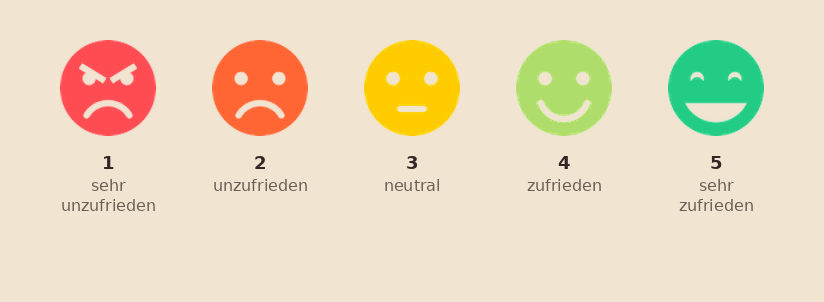
The CSAT value is the percentage of respondents who gave a rating of 4 or 5 — the so-called top-two-box. In market research it's considered the most robust predictor of customer retention; some studies argue instead for the top-box (5s only), which is a design decision. We recommend top-two-box as the default — established, stable, and easy to compare.
The value ranges between 0% (all dissatisfied) and 100% (all very satisfied). In practice, healthy CSAT values fall between 75% and 90% depending on the industry — a value that is consistently higher usually signals that the question was framed too vaguely or that the sample is selective.
What CSAT is strong at
CSAT is flexible. The question can be adapted to any aspect of the interaction between customer and company — and that's exactly its most common application.
- Touchpoint diagnostics — "How satisfied were you with your last call to the hotline?" Instantly delivers a comparison value for service quality across shifts and locations.
- Product and process feedback — "How satisfied were you with the delivery of your order?" or "How satisfied were you with the salesperson's helpfulness?" Several CSAT questions combined in one survey give you a differentiated diagnostic picture.
- Trend measurement — same wording, same scale, defined waves. Changes over time are immediately readable.
Where CSAT reaches its limits
CSAT captures a snapshot — the impression after exactly one touchpoint with the company. About the long-term customer relationship, the value says nothing directly.
A customer who was "very satisfied" with their last call to the hotline may still switch at the next contract renewal — because the overall balance of price, product quality, and competing offers looks different. If you want to measure loyalty and willingness to recommend, you need the Net Promoter Score (NPS). If you want to capture the perceived effort in resolving a problem, you need the Customer Effort Score (CES).
CSAT, NPS, CES — which question measures what?
- CSAT — satisfaction after a touchpoint. "How satisfied were you with [interaction]?" Point-in-time diagnostics.
- NPS — loyalty and willingness to recommend. "How likely are you to recommend us?" A strategic indicator.
- CES — effort experience in problem resolution. "The company made it easy for me to resolve my issue." Friction diagnostics.
For an overview of the combined use of NPS, CSAT, and CES, see the page NPS, CSAT, and CES in QUESTIONSTAR.